Strength training after 40: what most “best exercise” lists miss
There have been quite a few articles and posts lately about the “best” exercises to do.
Best exercise for strength.
Best exercise for ageing well.
Best exercise for your core.
Best exercise everyone over 40 should be doing.
And I understand why people like that kind of content. It is simple. It is easy to save. It makes you feel like there is one clear answer. But bodies do not really work like that. And normal life definitely does not either.
Why “best exercise” advice is incomplete
A lot of fitness content online is made to be catchy, not necessarily useful.
One person says everyone should squat. Someone else says squats are bad for your knees. One video says deadlifts are essential. Another says deadlifts are dangerous. Then someone with perfect lighting and no visible responsibilities tells you all you need is discipline and a 5 am routine.
It gets noisy.
And I think a lot of normal people end up stuck between two extremes. On one side, there is the “just do this one exercise” advice. On the other side, there is the very intense fitness world where everything looks hard, fast, sweaty and a bit intimidating.
Neither is particularly helpful if you are just trying to start again. Especially if you are over 40, busy, tired, a bit stiff, carrying old injuries, dealing with work, family, stress, hormones, confidence or just the feeling that your body does not respond exactly the way it did 20 years ago.
That is normal.
It does not mean you are lazy.
It does not mean you have left it too late.
It does not mean you need to punish yourself back into fitness.
It usually just means you need a more sensible way in.
What actually matters after 40
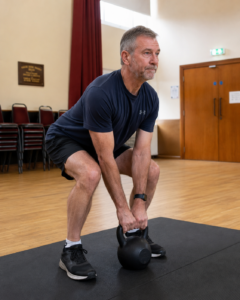
For most adults, strength training after 40 is not really about finding one magic exercise. It is about covering the basics often enough, in a way your body can actually tolerate and repeat.
Can you hinge?
Can you squat to a level that works for your body?
Can you carry something without your back doing all the work?
Can you get up and down from the floor?
Can you balance a little better than last month?
Can you rotate, brace, reach, step, push and pull without everything feeling awkward?
That is the stuff that matters. Not because it looks impressive online. Because it shows up in normal life.
Useful strength training for everyday life
Strength training after 40 should help with normal, everyday things.
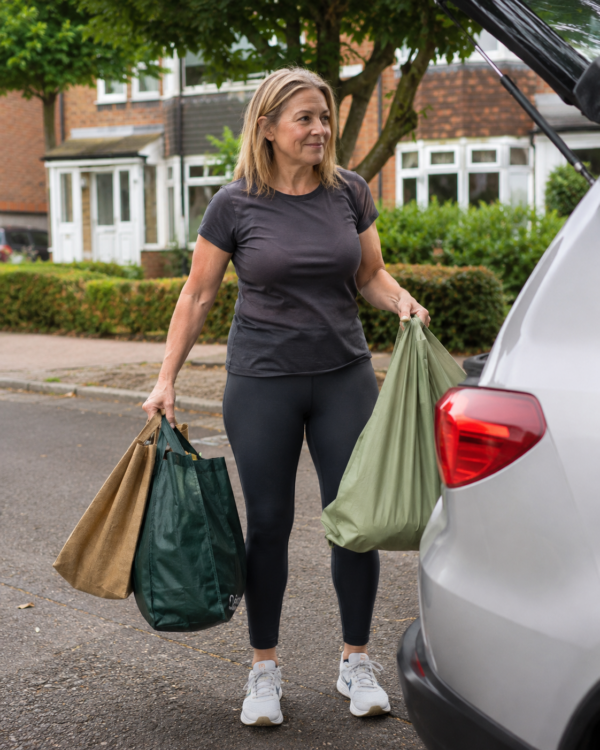
Carrying shopping.
Getting out of a low chair.
Walking upstairs.
Gardening.
Picking something up from the floor.
Playing with kids or grandkids.
Feeling steadier on uneven ground.
Not feeling so stiff every time you stand up.
That is strength training too. It just does not always look dramatic.
A deadlift can be useful.
So can a squat.
So can a carry.
So can mobility work.
But none of them is magic on their own.
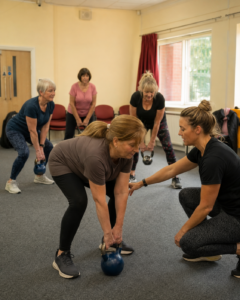
The value is in building a small, repeatable base — something we also focus on in our small group kettlebell classes in Chessington.
A bit of lower body strength.
A bit of upper body strength.
A bit of core control.
A bit of balance.
A bit of mobility.
A bit of conditioning.
A bit of confidence.
Repeated often enough that your body starts to trust it again. That is not as exciting as a headline. But IT WORKS. And it is usually what people actually need.
Context matters more than the perfect exercise
That might mean deadlifts for one person.
Box squats for another.
A wall press-up instead of a floor press-up.
A kettlebell carry instead of a complicated core exercise.
A supported split squat instead of a lunge.
A hip hinge with no weight before adding load.
A few minutes of mobility before you even think about going heavier.
That is the part social media often skips.
The regression.
The adaptation.
The context.
The fact that two people can need completely different versions of the same movement.
Someone might say, “everyone should squat”. Fine. But what kind of squat? How low? With what load? With what knees, hips, ankles, back, confidence and training history?
Someone might say, “deadlifts are the best exercise”. Maybe. But not if the person has never learned how to hinge, rushes the movement, feels it all in their lower back, and then decides strength training is not for them.
Someone might say, “just do planks for core”. But can the person breathe? Can they brace? Can they control their pelvis? Can they use their core when they pick something up or carry something?
That is why “best exercise” advice is always a bit incomplete. It removes the human being from the exercise. And the human being is the whole point.
If you want more individual support with technique, strength and mobility, personal training with Alexia in Chessington gives you a more specific way to build confidence at your own pace.
What most adults really need
For most people, the answer is not to find the perfect movement.
It is to build a small, repeatable base.
Not random workouts that change every five minutes.
Not punishment sessions.
Not copying someone half your age on Instagram.
Not feeling like you have failed because you cannot do the advanced version yet.
Not being told that everything is simple if you “just want it badly enough”.
Most people do not need to be shouted at.
They need to understand what they are doing.
They need exercises that make sense.
They need options.
They need enough challenge to progress, but not so much that they dread coming back.
They need to feel like training belongs in their life, not like it is another thing they are failing at.
That is why I think the “best exercise” conversation is only useful up to a point.
The better question is probably:
What does your body need to keep doing well?
Do you need to get stronger?
Do you need to move more often?
Do you need more confidence with lifting?
Do you need to feel steadier?
Do you need to stop avoiding the things that feel awkward?
Do you need a bit more structure so you are not just guessing?
Because the goal for most adults is not to win the internet. It is to keep moving, keep lifting, keep doing life, and feel a bit more confident in your own body.
Most people do not need a perfect exercise. They need useful training they can come back to.
Strength training in Chessington for adults 40+
At The London Kettlebell Club, we focus on strength training that feels useful, realistic and repeatable. Our small group strength training in Chessington is built around kettlebells, mobility, simple conditioning and fully coached sessions for adults 40+.
You can view our kettlebell class prices in Chessington or learn more about personal training with Alexia if you want more individual support.